AI Amazon Images: What Actually Converts (And What Kills Your Listing)
Every week I talk to Amazon sellers who spent $800 on a photographer and still have a 4% conversion rate. The images look fine. They just don't sell. AI Amazon images are changing what's possible for sellers and the agencies managing them. But the tool is only as good as the brief behind it. And most sellers still don't know what separates a converting image from a pretty one.
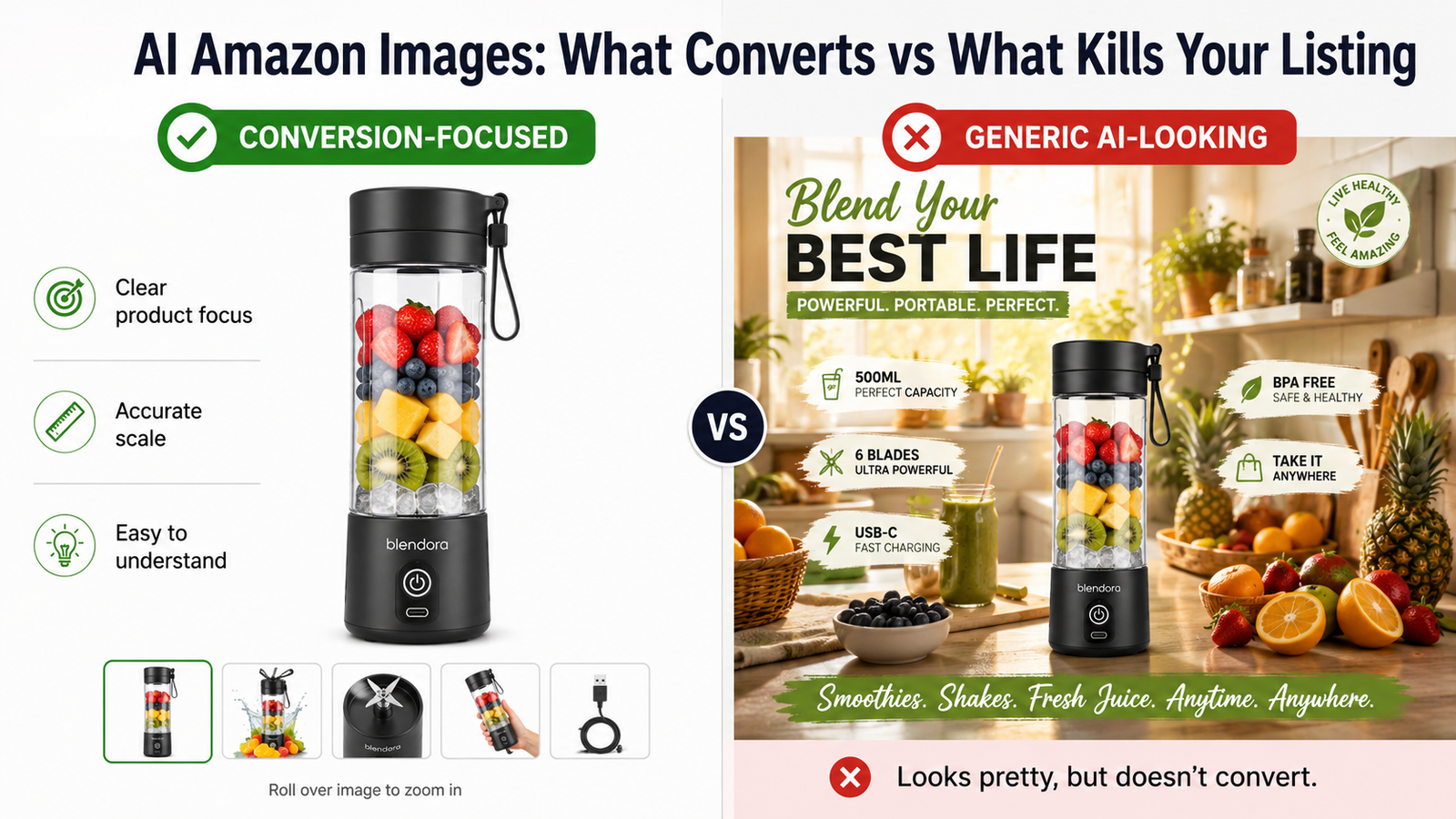
Every week, I speak with Amazon sellers who have spent hundreds, sometimes thousands, of dollars on product photos. The images look polished. The lighting is good. The product is sharp. On paper, everything seems fine.
But the listing still converts at 4%.
That is the problem most sellers do not talk about enough: a good-looking image is not always a selling image.
AI Amazon images are changing what is possible for sellers, agencies, and e-commerce teams. You can now create main images, lifestyle shots, infographics, comparison graphics, and A+ Content much faster than before. But AI does not magically fix a weak creative strategy. In fact, if you use it badly, it can make your listing look even more generic.
The real question is not, “Can AI create Amazon images?”
It can.
The better question is, “Can those images make a buyer click, trust, and buy?” That is where most listings win or lose.
What Are AI Amazon Images?
AI Amazon images are product visuals created or enhanced using AI tools for Amazon listings. They can include main images, lifestyle scenes, feature graphics, infographics, comparison images, and A+ Content modules.
In simple terms, AI helps sellers produce the kind of product visuals that used to require photographers, designers, editors, and multiple review rounds.
But the image still needs to do the same job: sell the product.
Before a customer reads your bullets, checks your reviews, or compares your price, they see your image. That first image decides whether they even click. Then the rest of the carousel decides whether they believe the product is right for them.
This is why image quality matters so much on Amazon. Your images are not decoration. They are your first sales pitch.
At Saharan AI, we have worked on image workflows for 360-plus brands through agency partnerships, with no paid acquisition or outbound ads. Across those brands, the same patterns keep showing up.
The listings that convert are not always the prettiest.
They are the clearest, most specific, and easiest to trust.
The Simple Answer
AI Amazon images are product visuals created or optimized using AI generation tools for Amazon listings. The best AI Amazon images show the product clearly, communicate the main use case quickly, match what the buyer expected to see, and follow Amazon’s image requirements.
Bad AI Amazon images usually fail for a few reasons: the product looks fake, the scale is wrong, the background is distracting, the image feels generic, or the AI changes small details that buyers notice subconsciously.
Used well, AI can cut production time dramatically while still producing images that feel specific to the product, the category, and the buyer. Used badly, it creates polished images that look impressive but do not convert.
What Does a Good Amazon Product Image Actually Do?
A good Amazon image does one job: it helps the buyer feel confident before doubt appears. When someone searches for “stainless steel insulated water bottle 32oz,” they already have a picture in their head. They know roughly what they expect to see. Your main image either matches that expectation quickly or it creates friction.
If the buyer has to think too hard, they scroll. That is the harsh truth of Amazon. You do not get much time. Strong Amazon product images usually do four things well.
First, they show the product at the right scale.
This is one of the most common failures in AI-generated images. The scene looks beautiful, but the product size feels wrong. A bottle looks too small. A backpack looks huge. A skincare bottle looks like it belongs in a hotel bathroom when it is actually a full-size product.
Scale matters because it tells the brain whether the image is believable. If the scale feels off, the product feels fake.
Second, the main image keeps the product as the hero.
For the main image, the product should be clear, centered, and easy to understand. No visual noise. No unnecessary props. No background that competes with the product.
This is not just about following Amazon’s requirements. It is about reducing friction. The faster the customer understands what the product is, the easier it is for them to click.
Third, the secondary images answer the buyer’s objections.
Most sellers treat the image carousel as a gallery. They show the product from different angles and hope that is enough.
But a strong carousel is more like a sales conversation.
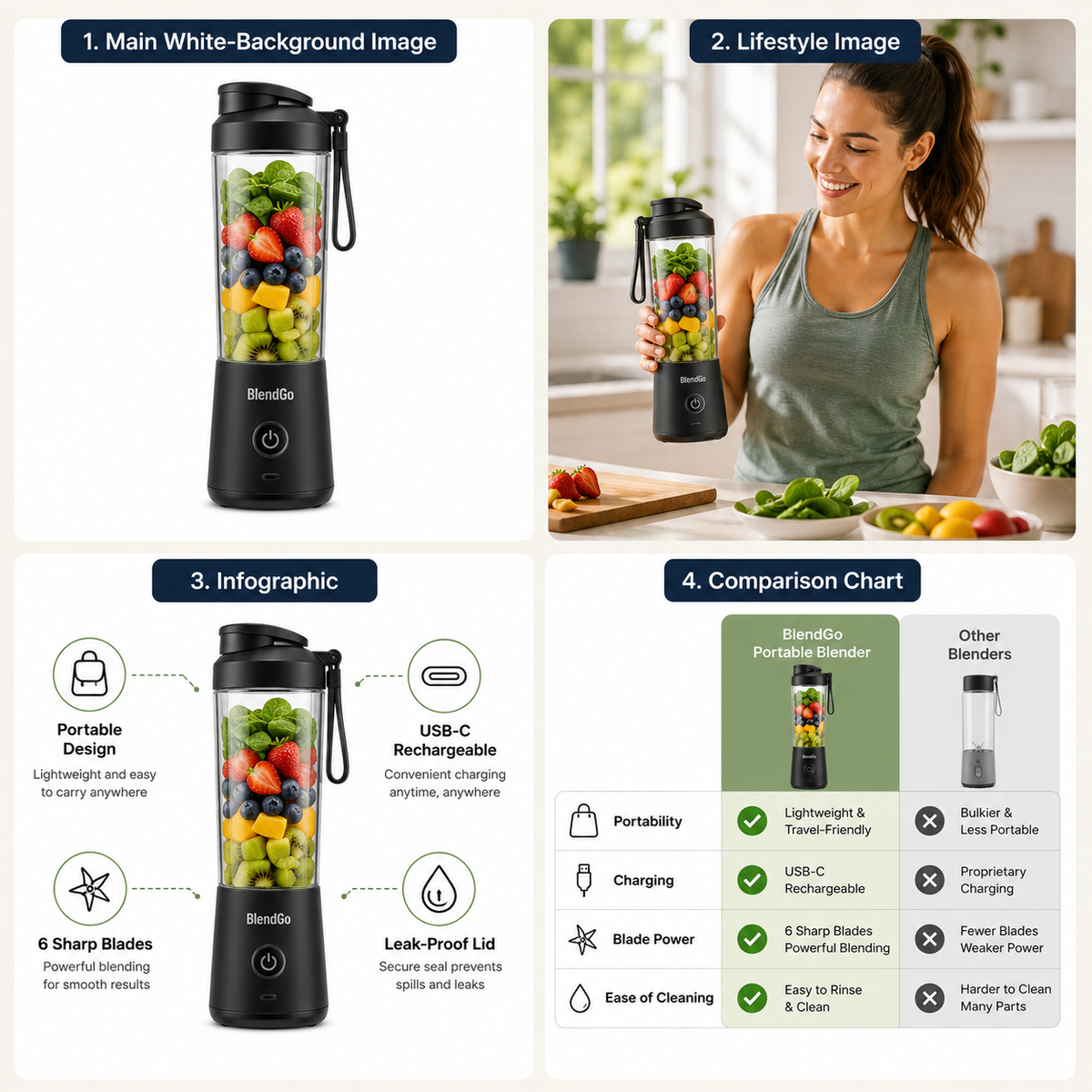
Image two might show the core benefit. Image three might show the product in use. Image four might explain size or materials. Image five might compare it to alternatives. Image six might show trust signals, certifications, or what is included in the box.
Each image should answer one question the buyer has in their head.
Fourth, the color and product details must stay accurate.
This is especially important with AI. Some AI tools subtly change product colors, textures, labels, stitching, handles, packaging, or proportions. At first glance, the image may look better. But if the product that arrives does not match the image, you create returns, bad reviews, and lower trust.
A navy product cannot become black. A cream product cannot become bright white. A matte bottle cannot suddenly look glossy.
AI should improve the selling image, not invent a different product.
What Makes a Low-Conversion Amazon Image?
You can usually tell within a few seconds when an Amazon image is not working.
The first problem is a background that competes with the product.
Lifestyle images are useful, but only when the scene supports the product. A dark product on a dark background is hard to read. A busy kitchen scene can make the customer search for the item being sold. A beautiful beach background does not help if the product disappears inside it.
The second problem is an image that looks technically clean but emotionally empty.
This is one of the biggest AI tells. The lighting is perfect. The scene is perfect. The model is perfect. The surface is perfect.
And somehow, the whole thing feels fake.
Real product images have texture. They have use. They have believable imperfections. A product can look premium without looking sterile. Buyers may not say, “This was made with AI,” but they will feel that something is off.
The third problem is no proof of scale or context.
If the product floats in white space across every image, the buyer has to guess how big it is. Guessing creates doubt. Doubt kills conversion.
One image showing the product in someone’s hand, next to a common object, inside a real space, or being used in a realistic situation can remove that doubt immediately.
The fourth problem is text-heavy infographics.
A wall of text placed on top of a product photo is not an infographic. It is just a bullet list pretending to be design.
Good infographics communicate one idea at a time. “BPA Free.” “Keeps drinks cold for 24 hours.” “Fits standard cup holders.” Simple, clear, visual.
If the customer has to zoom in to understand the image, the image is doing too much.
The fifth problem is AI artifacts on the product itself.
This is the easiest mistake to miss when you are reviewing your own images. A label bends incorrectly. A handle changes shape between images. A strap appears on one image and disappears in the next. A logo becomes slightly distorted. A human hand has strange fingers. A reflection shows something impossible.
These details matter because Amazon buyers are trained to detect risk. If the image feels unreliable, the product feels unreliable.
How AI Changes the Amazon Image Workflow for Agencies
The old production process was slow.
An agency or seller would brief a photographer, ship the product, schedule a shoot, wait for raw files, send them to an editor, review the first version, request changes, and wait again.
For many products, this could take three weeks or more. It could also cost hundreds or thousands of dollars per SKU, especially when lifestyle scenes, models, or multiple product variations were involved.
AI changes the workflow completely.
A strong AI image workflow can usually produce high-quality first drafts in days instead of weeks. The cost drops because teams do not need to rebuild every scene from scratch. More importantly, agencies can test more creative directions before committing to one.
But speed is only useful if the output is still accurate.
The best agency workflows do not just type a prompt and hope for the best. They start with product information, brand positioning, customer objections, Amazon category context, and visual references. Then AI is used to generate assets around a clear sales logic.
That is the difference between “make a nice image” and “make an image that helps this specific product sell.”
A Better Amazon Image Carousel Structure
A strong Amazon image carousel should not repeat the same message seven times.
A simple structure looks like this:
Image one should make the product instantly clear. This is your main image. It should be clean, accurate, and easy to understand.
Image two should communicate the main benefit. Why should the buyer care?
Image three should show the product in use. Help the buyer imagine owning it.
Image four should explain scale, size, or materials. Remove uncertainty.
Image five should show key features visually. Do not overload it with text.
Image six should answer a common objection. This could be durability, compatibility, safety, quality, or what is included.
Image seven should create confidence. This could be a comparison, certification, review-based insight, or brand trust image.
This structure works because it follows the buyer’s thought process. First they ask, “What is it?” Then, “Is it for me?” Then, “Can I trust it?” Then, “Why this one?”
Your images should answer those questions before the buyer has to search for the answer elsewhere.
Where AI Works Best for Amazon Images
AI is especially useful for creating lifestyle variations, testing different visual angles, building cleaner infographics, and adapting a product image to different buyer segments.
For example, a kitchen product might need one image that feels family-focused, one that feels premium and minimalist, and one that highlights storage or space-saving benefits.
Traditionally, testing all of those directions would be expensive. With AI, you can create and compare multiple creative routes much faster.
AI is also useful when a seller has limited product photography. Many sellers only have a few basic product photos. With the right workflow, those images can become a full listing image set, including lifestyle shots, use-case visuals, infographics, and A+ Content.
But AI should not be used to fake product capabilities.
Do not show the product doing something it cannot do. Do not change the material. Do not exaggerate size. Do not invent accessories that are not included. Do not make the product look more premium than what the customer will receive.
The goal is not to trick the buyer.
The goal is to help the buyer understand the real product faster.
The Biggest Mistake Sellers Make With AI Amazon Images
The biggest mistake is treating AI like a cheaper designer instead of a better workflow.
If you only use AI to make random pretty images, you will end up with random pretty images. Some may look good. Some may even impress your team. But that does not mean they will sell.
The better approach is to start with the buyer.
What are they worried about? What do they compare this product against? What detail do they need to see before buying? What would make them trust the product faster? What does the product need to communicate in the first second?
Once you know that, AI becomes powerful.
It helps you create faster, test more ideas, and produce listing visuals that are more specific than generic template-based design.
Final Thoughts
AI Amazon images are not a shortcut around good selling logic.
They are a way to execute that logic faster.
A strong Amazon image does not just show the product. It removes doubt. It answers objections. It creates trust. It helps the buyer see the product in their life.
That is what converts.
The sellers and agencies that win with AI will not be the ones making the flashiest images. They will be the ones building the clearest visual sales system around each product.
Because on Amazon, pretty is not enough.
The image has to sell.